
What lies beneath the bonnet of your electric car? A guide to the world of EV batteries
Reading time: 8 – 10 minutes
When you buy an electric car, you receive one of the most expensive and important technologies that exists today. The battery is not just a "tank for electricity" – it is the heart of the entire vehicle. And just like with people, not every heart beats the same way.
Some batteries love heat, others tolerate it worse than a Scandinavian tourist on a Sicilian beach. Some will handle being charged to 100% every day without batting an eyelid, while others will "thank" you a few years later with a reduced range. And some will give you a fantastic range but require careful handling.
This article will tell you exactly what you have in your car, why it matters – and how to put that knowledge into practice when charging your electric car at home. We will explain the difference between LFP vs NMC, show you how to charge your electric vehicle correctly according to battery type, and tell you what really affects EV battery degradation and its lifespan.
Quick summary: LFP batteries are ideal for everyday charging to 100%, while NMC and NCA batteries prefer a limit of around 80%. The battery type significantly affects lifespan, charging behaviour and how the electric car performs in winter.
Why should you care about battery type at all?
You might be thinking: "I drive, I charge, I move on. Why do I need to know what's inside?" An understandable attitude. But imagine if you were filling your car with diesel instead of petrol because nobody told you the difference. The result would be equally unpleasant.
With electric cars it is not quite as dramatic, but the principle holds. Battery type directly affects:
- How you charge – to what percentage, how often, at what power level
- How long the battery lasts – whether in 5 years you will have 90% capacity or 70%
- How it behaves in winter – some chemistries handle this significantly better
- How much you will pay for a potential replacement – and whether it will ever come to that
In short: knowing your battery type can extend its lifespan by years. And that is no small thing.
The basics you need to know: what exactly is a lithium-ion battery?
Almost all electric cars today use lithium-ion batteries – hence the abbreviation "Li-ion". However, this is not a single type but an entire family of technologies that share a common principle while differing in electrode composition.
Simply put: a battery has a positive electrode (cathode) and a negative electrode (anode). Lithium ions flow between them, generating electrical energy. The magic – and the mystery – lies in the cathode material. It determines almost everything: power output, capacity, safety, lifespan and cost.
And it is precisely by cathode material that we divide batteries into the groups you will learn to identify today.
LFP – the quiet and reliable marathon runner
Full name: Lithium Iron Phosphate (LiFePO₄)
Used in: Tesla Model 3 and Model Y (basic Standard Range versions), BYD Atto 3, BYD Seal, MG4, Volvo EX30, Dacia Spring
An LFP battery is like a reliable colleague who never lets you down. It will not deliver record-breaking performance, but it always shows up on time, lasts a long time and never demands special treatment.
What makes LFP exceptional?
- You can charge it to 100% every day – without any concerns whatsoever. The chemistry simply handles it.
- Exceptional lifespan – some LFP batteries last 3,000 to 5,000 charging cycles. That is comfortably 15–20 years with normal use.
- Thermal stability – LFP is the least susceptible to so-called thermal runaway, i.e. uncontrolled overheating. It is the safest widely available chemistry.
- Cost – it contains no cobalt, which significantly reduces manufacturing costs.
What are the trade-offs?
- Lower energy density – for the same range you need a heavier and larger battery than with NMC.
- Winter performance – LFP temporarily loses power in the cold and charging speed can drop more noticeably than with NMC. If you live in the north and charge outdoors, you may feel this.
- Voltage curve – LFP has a "flat" curve, which makes it harder to read the actual state of charge (SOC). As a result, some cars with LFP display the battery level less accurately.
💡 Charging tip for LFP: Charge to 100% without hesitation – that is precisely what this battery is designed for. It is even recommended to charge to full at least once a month so that the BMS (battery management system) can properly calibrate its data.
NMC – the powerful sprinter with a long range
Full name: Nickel Manganese Cobalt (Li-NMC)
Used in: Škoda Enyaq, Volkswagen ID.4 and ID.5, Hyundai Ioniq 5 and Ioniq 6, Kia EV6, BMW iX, Audi Q4 e-tron, Renault Megane E-Tech, Mercedes EQA/EQB
NMC is currently the most popular chemistry in European electric cars. If you drive one of the vehicles listed above, there is a high probability that you have an NMC battery.
Where does NMC excel?
- High energy density – more kilometres per kilogram of battery. This is why NMC cars have a longer range at lower weight.
- Good winter performance – better cold resistance than LFP.
- Fast charging – NMC batteries typically support higher charging power levels.
Where do you need to be careful?
- Charging to 100% is not ideal – NMC degrades faster with daily full charges. The recommended limit is 80%, or 90% for long trips.
- Cobalt in the composition – makes the battery more expensive and raises ethical questions (cobalt mining has environmental and social impacts).
- Thermal sensitivity – requires a quality cooling system.
💡 Charging tip for NMC: The ideal daily charging limit is 80% – you can set this limit directly in your car's settings (VW, Hyundai, Kia and Škoda all support this). For a long trip, temporarily increase it to 100%, but do not leave the car sitting at full charge for several hours unnecessarily.
NCA – the premium league with demands
Full name: Nickel Cobalt Aluminium (Li-NCA)
Used in: Tesla (mainly models with Panasonic cells – Long Range and Performance versions), Lucid Air
NCA is the chemistry that Tesla, in collaboration with Panasonic, pushed to the pinnacle of performance. It is the Formula 1 of the battery world – maximum power, maximum speed, but also maximum demands on care.
- Highest energy density – more energy per kilogram than anyone else in mass production
- Excellent range – the Tesla Model S with an NCA battery still ranks among the electric cars with the longest range in the world
- More demanding thermal management – requires sophisticated cooling systems
- Cost – NCA is more expensive to manufacture and repair
💡 Charging tip for NCA: Same as NMC – daily charging ideally to 80–90%. Tesla directly offers the option to set a charging limit in the car's settings.
NMCA and new generations – where is the future heading?
Battery manufacturers are not standing still. NMCA (Nickel Manganese Cobalt Aluminium) is a hybrid of NMC and NCA – it tries to take the best of both worlds. Some manufacturers including Hyundai/Kia are experimenting with NMCA-type cells in newer battery generations, although specific models are not always officially communicated.
However, a revolution that has been talked about for years is on the horizon – the solid-state battery (a battery with a solid electrolyte). Instead of a liquid electrolyte it uses a solid material, which brings:
- Significantly higher energy density (theoretically 2× more than NMC)
- Faster charging
- Greater safety (no flammable liquid)
- Longer lifespan
Toyota, Samsung SDI, QuantumScape and others are investing billions in development. Mass production is estimated for the years 2027–2030. When it arrives, it will completely change the rules of the game.
How do I find out what battery my car has?
An excellent question. Unfortunately, manufacturers sometimes keep this information hidden or only include it in technical documentation that nobody reads. Here are several ways to find out:
1. By car model and year
This is the quickest method. Most models have an assigned chemistry according to version:
| Model | Version / year | Battery type |
|---|---|---|
| Tesla Model 3 / Y | Standard Range (SR) | LFP |
| Tesla Model 3 / Y | Long Range / Performance | NCA (some newer versions from China: NMC) |
| Škoda Enyaq | All versions | NMC |
| VW ID.4 / ID.5 | All versions | NMC |
| Hyundai Ioniq 5 / 6 | All versions | NMC / NMCA |
| Kia EV6 | All versions | NMC |
| BYD Atto 3 / Seal | All versions | LFP (Blade Battery) |
| MG4 | Standard Range | LFP |
| MG4 | Long Range | NMC |
| Renault Zoe | Older generations | NMC |
| Dacia Spring | All | LFP |
| Volvo EX30 | Standard Range | LFP |
| Peugeot e-208 / e-2008 | All | NMC |
2. Via the car's app or on-board computer
Some cars (Tesla, BYD) display the battery type directly in settings. Look for the "Battery" or "About Vehicle" section.
3. Via OBD-II diagnostics
If you have an OBD-II adapter and an app such as Car Scanner, Torque Pro or manufacturer-recommended software, you can view detailed battery parameters including the chemistry (if the car reports it).
4. By charging behaviour
This is a bit of detective work, but it works:
- If your car charges at a steady rate from 20% to 90% and only slows down at the end – probably LFP
- If charging speed drops noticeably from around 75–80% – typical for NMC/NCA
- If the manufacturer recommends charging to 80% in the manual – NMC or NCA
- If the manufacturer says you can charge to 100% daily – LFP
5. Vehicle registration document / certificate
In some countries (and with some models) you will find the battery type directly in the vehicle documentation or in the COC document (Certificate of Conformity) that you receive when purchasing.
🔍 Quick test: Open your car's manual and search for "battery chemistry", "battery type" or "Akku-Chemie". If you find nothing, try Google with the exact model and year + "battery chemistry" – electric vehicle communities discuss this extensively.
How does battery type affect home charging?
Now we get to the heart of the matter. Knowledge of your battery type is a wonderful thing – but what do you do with it?
Does AC charging speed affect battery degradation?
Short answer: no, practically not at all. Here is why.
When you charge via a wallbox, you deliver alternating current (AC) to the car. However, this does not go directly to the battery – it first passes through the on-board charger (OBC) built into the car, which converts it to direct current (DC) and simultaneously regulates the power, current and temperature. The OBC is essentially an intelligent guardian of the battery – it will not let anything through that could harm it.
Battery degradation during home charging is not affected by wallbox power output, but by:
- State of charge – an NMC battery regularly sitting at 100% degrades faster
- Temperature – charging in freezing weather without pre-conditioning the battery
- Depth of discharge – regularly discharging below 10–15%
The situation is different with DC fast charging (CCS posts on motorways) – here the on-board charger (OBC) is bypassed and high power flows directly to the battery under the control of the vehicle's BMS system. With daily use, the increased load on the battery becomes noticeable. Home AC charging of an electric car is in most cases gentler than regular high-power DC charging – and this is precisely why having a wallbox at home is so important for battery lifespan.
LFP car → charge without worry
Do you have a BYD, a base Tesla or an MG4 Standard? Congratulations – you have the most resilient widely available battery. Set the wallbox to 100% and forget about it. The battery not only handles it, but actively wants you to do it.
NMC/NCA car → be a little more considerate
Do you have an Enyaq, ID.4 or Ioniq 5? Set a daily charging limit of 80% in your car. For a long trip, temporarily increase it to 90–100%, but do not regularly leave the car sitting at 100% for several hours unnecessarily.
Why? An NMC battery at a high state of charge (close to 100%) accelerates degradation due to chemical stress in the cells. It is not a disaster – the car will last years – but with correct charging you can preserve capacity significantly longer.
A smart wallbox as your charging assistant
And this is where modern wallboxes come into play. While the V2C Trydan does not control the battery's state of charge (that is the job of the car and OBC), it offers tools that make smart electric vehicle charging significantly easier and more cost-effective.
One of the most useful features is charging time windows. In the Trydan app you set during which hours the wallbox should charge – for example only from 10 PM to 6 AM, when electricity is cheaper on the night-time tariff. You plug the car in as soon as you get home, but Trydan only starts charging when it makes economic sense. In the morning you leave with a charged car and a lower electricity bill.
In addition, Trydan features solar charging – if you have photovoltaics, the car will preferentially charge from surplus solar energy. You do not need to buy electricity from the grid – you use what you would otherwise "sell" for a fraction of the price.
👉 View the V2C Trydan at ev-nabijacky.sk
EV battery myths it is time to bust
❌ Myth 1: "An electric car battery only lasts 5 years"
Reality: Modern batteries (especially LFP) last 15–20 years with proper care. Most manufacturers guarantee at least 70% of original capacity after 8 years or 160,000 km – in practice, results with proper maintenance are often better.
❌ Myth 2: "Daily charging destroys the battery"
Reality: It depends on the chemistry and how many percent you charge to. LFP – charge every day without concern. NMC – charge every day, but to 80%. Correct home charging of an electric vehicle is the foundation of a long battery lifespan.
❌ Myth 3: "Fast charging destroys the battery"
Reality: Occasional DC fast charging on a journey is fine. The problem arises when daily DC fast charging becomes the primary charging source. Home AC charging via a wallbox is in most cases gentler than regular high-power DC charging.
❌ Myth 4: "You need to let the battery drain to 0%"
Reality: No! Deep discharging (below 10–15%) damages the battery. Ideally charge within the window of 20–80% (NMC) or 10–100% (LFP).
Summary: what to take away from this?
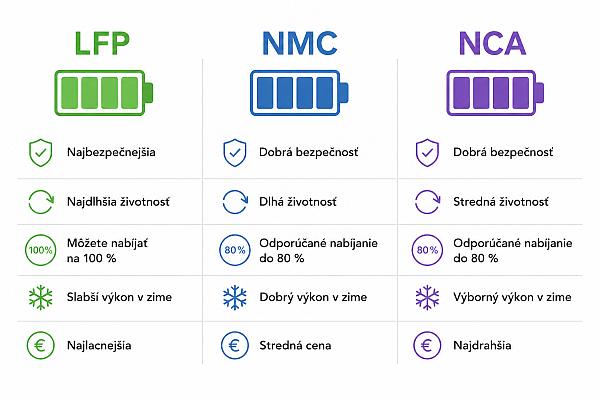
| Type | Charge to | Do not discharge below | Lifespan | Winter |
|---|---|---|---|---|
| LFP | 100% (recommended) | 10% | ⭐⭐⭐⭐⭐ | ⭐⭐⭐ |
| NMC | 80% (daily), 100% (trips) | 15% | ⭐⭐⭐ | ⭐⭐⭐⭐ |
| NCA | 80–90% (daily) | 15% | ⭐⭐⭐ | ⭐⭐⭐⭐ |
| NMCA | 80% (daily) | 15% | ⭐⭐⭐⭐ | ⭐⭐⭐⭐ |
Frequently asked questions about electric car batteries
Can I charge an LFP battery to 100% every day?
Yes. LFP batteries are designed for regular charging to 100% and it even helps the BMS system calibrate accurately. Unlike NMC batteries, full charging does not harm them.
Is DC fast charging harmful to an electric car battery?
Occasional DC fast charging on journeys is not a problem. However, when used daily as the primary charging source, it can accelerate battery degradation more than home AC charging via a wallbox.
What is the difference between an LFP and NMC battery?
LFP batteries have a longer lifespan, greater safety and can be charged to 100% daily. NMC offers higher energy density (longer range at lower weight) and better winter performance, but the ideal charging limit is 80%.
How do I find out what battery my electric car has?
The simplest method is to look up your model and year online or check the car's manual. You will also find a clear table of the most popular models with their battery type in this article.
Does wallbox power output (11 kW vs 22 kW) affect battery degradation?
No. The power output of a home wallbox has no direct effect on battery degradation, because the on-board charger (OBC) in the car regulates how much energy the battery actually receives. Degradation is primarily affected by state of charge, temperature and depth of discharge.
Conclusion: You know your car. Now charge it correctly.
An electric car battery is a fascinating technology – and at the same time an investment worth looking after. All you need to do is know which type you have and set up home electric car charging accordingly. No rocket science, no daily percentage monitoring. Whether you are looking for a wallbox for a Tesla, a Škoda Enyaq or a BYD, the rules are clear and straightforward.
To do this without having to think about it, you need the right wallbox. One that lets you set charging time windows, monitor consumption and intelligently charge from solar panels.
That is exactly what the V2C Trydan does – and we would be happy to introduce it to you in person, right at your home.
Contact us – a site visit and consultation are free of charge.
Author: ev-nabijacky.sk team – specialists in home electric vehicle charging and smart wallboxes. | Updated: May 2026